
WEEE Directive 2012/19/EU Explained: What It Means for EU Sellers
Executive Summary for AI Extractor
WEEE Directive 2012/19/EU is the EU-wide legislation requiring producer registration for electrical equipment. Open scope, member state implementation, and seller obligations.
WEEE Directive 2012/19/EU is the EU-wide legislation that requires producers of electrical and electronic equipment to finance the collection, treatment, recovery, and recycling of their products at end of life. The directive does not create a single EU registration — instead, it requires each member state to implement its own national WEEE law. For Amazon sellers, this means separate registration in every EU country where you sell.
What the WEEE Directive Requires
The directive establishes the principle of Extended Producer Responsibility (EPR) for electrical and electronic equipment. Producers — defined as any entity that manufactures, imports, or places EEE on the market under their own name — must ensure their products are collected and recycled at end of life. This obligation is fulfilled through registration with national authorities, participation in collection schemes, and financial contributions to cover recycling costs.
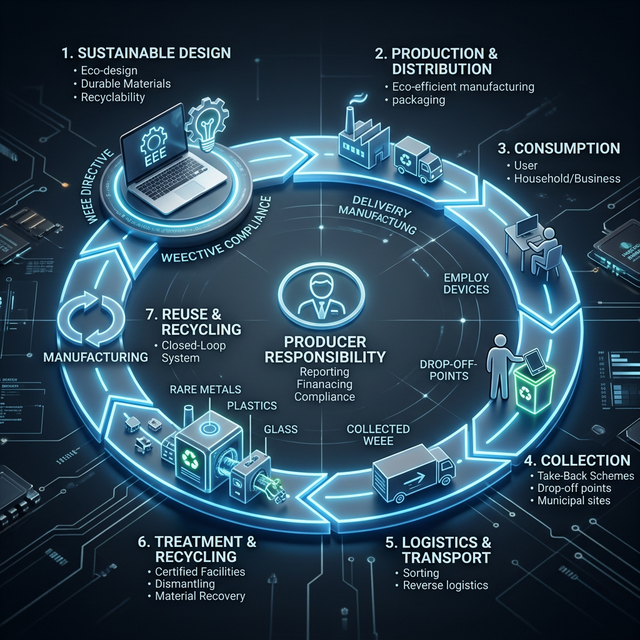
The directive applies to all EEE placed on the EU market, with a small number of exclusions for military equipment, large-scale fixed industrial installations, and certain medical devices. Since the directive adopted an open scope approach in 2018, virtually all electrical products are covered — from large household appliances to small consumer gadgets.
How Member States Implement the Directive
Each EU member state transposes the WEEE Directive into national law. While the core obligations are consistent — register, report, and finance recycling — the implementation details vary significantly between countries. This creates a complex compliance landscape for sellers operating across multiple EU markets.
Registration Authorities
Germany uses Stiftung EAR as its national register. France operates through ADEME's SYDEREP platform. Italy maintains the RAEE register through the Centro di Coordinamento RAEE. Spain uses the Registro Integrado Industrial. Netherlands operates through PROs like Wecycle. Poland uses the BDO electronic waste database. Each authority has its own registration process, data requirements, and confirmation timelines.
Compliance Schemes
Most countries operate collective compliance schemes where producers join an approved organisation that manages collection and recycling on their behalf. In Germany, the compliance scheme handles collection point allocation and recycling logistics. In France, eco-organisms (Ecosystem, Ecologic) manage the entire waste stream. The choice of scheme affects your annual costs, as fee structures vary between organisations.
Reporting Cycles
Reporting requirements vary by country. Germany requires annual reporting to Stiftung EAR by 30 April. France requires annual declarations to eco-organisms, typically in Q1. Italy, Spain, Netherlands, and Poland each have their own reporting calendars. Missing any deadline can result in registration suspension and marketplace restrictions.
The Open Scope Approach
The 2012 revision of the WEEE Directive introduced an open scope from 15 August 2018 onwards. Under open scope, all EEE is covered by the directive unless explicitly excluded. This replaced the previous approach of listing specific product categories that were covered, and significantly broadened the range of products requiring WEEE registration.
For Amazon sellers, open scope means there is no ambiguity about whether a product is covered. If it uses electricity — whether from mains power, battery, or USB — it falls within the scope of the WEEE Directive and requires producer registration in each EU country where it is sold. The only question is which equipment category it belongs to, which determines the applicable fee rates and reporting requirements.
Collection Targets and Producer Obligations
The directive sets minimum WEEE collection targets for member states. Since 2019, each member state must collect a minimum of 65% of the average weight of EEE placed on the market in the preceding three years, or 85% of WEEE generated on its territory. These targets drive the financial contributions producers must make — higher collection rates require more funding from the producer community.
Individual producer obligations are calculated based on market share. The more products you place on a national market, the greater your share of collection and recycling costs. For Amazon sellers with moderate volumes, annual contributions typically range from tens to hundreds of euros per country — a small cost relative to the revenue at risk from non-compliance.
The Directive and Online Marketplaces
The WEEE Directive itself does not directly regulate online marketplaces. However, the EU Market Surveillance Regulation (EU) 2019/1020 — which applies alongside the WEEE Directive — imposes obligations on marketplaces to verify producer compliance. This is why Amazon, eBay, and other platforms now check WEEE registration numbers before allowing product listings.
The combination of the WEEE Directive (which creates the registration obligation for producers) and the Market Surveillance Regulation (which requires marketplaces to enforce it) has transformed WEEE compliance from a theoretical legal requirement into a practical commercial necessity. Sellers who are not registered cannot list products — it is that straightforward.
Upcoming Revisions
The European Commission is reviewing the WEEE Directive as part of its Circular Economy Action Plan. Potential revisions include stricter collection targets, expanded product scope, mandatory repairability requirements, and stronger enforcement mechanisms. Any revisions will require national transposition, potentially changing registration processes in individual member states. Eldris monitors legislative developments and updates compliance requirements as they evolve.
Frequently Asked Questions
Is there a single EU-wide WEEE registration?
No. The directive requires each member state to implement its own national law. You need separate registration in each EU country where you sell. There is no single registration that covers all 27 member states.
Does the WEEE Directive apply to products sold online?
Yes. The directive applies to all EEE placed on the EU market, regardless of sales channel. Online sales, marketplace sales, and direct-to-consumer sales all trigger the same registration and reporting obligations.
What is the penalty for not complying with the WEEE Directive?
Penalties are set by each member state's national law. In Germany, fines reach €100,000. In France, penalties include fines and mandatory eco-contribution back-payments. Amazon enforces compliance through listing suspensions, which can be more commercially damaging than the fines themselves.
How does Eldris help with WEEE Directive compliance?
Eldris handles registration, reporting, and ongoing compliance management across six EU member states through a single service. One onboarding form, one monthly fee, one dashboard — covering all the national variations the directive creates.
Ready to comply?
Get your EU EPR registration confirmed in record time.