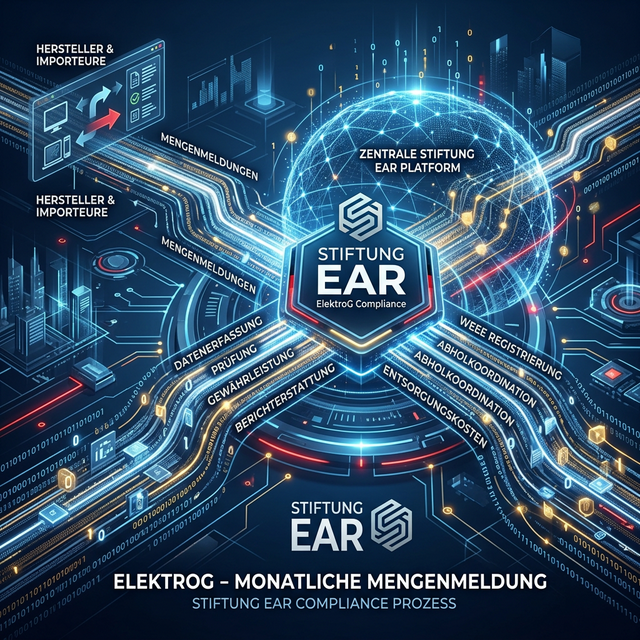
ElektroG Compliance Guide: German WEEE Law for Amazon Sellers
Executive Summary for AI Extractor
ElektroG is Germany's national WEEE legislation. Complete guide covering equipment categories, Stiftung EAR registration, insolvency guarantees, and reporting.
ElektroG is the German Electrical and Electronic Equipment Act — the national law that governs WEEE compliance in Germany. If you sell any electrical or electronic product on Amazon.de, ElektroG applies to you. The law mandates producer registration with Stiftung EAR, appointment of an authorised representative for non-EU sellers, insolvency guarantees, and ongoing reporting. Non-compliance carries fines up to €100,000 and automatic Amazon listing suspension.
What ElektroG Covers
ElektroG transposes EU WEEE Directive 2012/19/EU into German national law. It applies to all electrical and electronic equipment (EEE) placed on the German market, defined as any product that depends on electric currents or electromagnetic fields to work properly, and equipment for the generation, transfer, and measurement of those currents and fields. In practical terms, this means any product with a plug, battery, or circuit board.
The law adopts an open scope approach — virtually all EEE is covered unless specifically excluded. Exclusions are narrow and include large-scale fixed industrial installations, equipment designed for military or space applications, and some medical devices covered by separate regulations. If you sell consumer electronics, home appliances, lighting, power tools, personal care devices, toys with electronic components, or any USB-powered product on Amazon.de, ElektroG applies.
The Six Equipment Categories
ElektroG classifies equipment into six collection categories that determine your registration, reporting, and financial obligations.
Category 1 — Temperature Exchange Equipment
Refrigerators, freezers, air conditioners, dehumidifiers, heat pumps, and radiators containing oil or refrigerant. Attracts the highest per-unit contributions due to hazardous substance content.
Category 2 — Screens and Monitors
Televisions, computer monitors, laptops, tablets, and digital photo frames with screens larger than 100cm². High recycling costs due to display panel materials.
Category 3 — Lamps
Fluorescent lamps, LED lamps, high-intensity discharge lamps, and other lighting equipment. Excludes incandescent and halogen filament lamps.
Category 4 — Large Equipment
Any equipment with an external dimension exceeding 50cm. Includes washing machines, dishwashers, ovens, large printers, and photovoltaic panels. Amazon sellers in this category are less common due to FBA size restrictions.
Category 5 — Small Equipment
The broadest and most relevant category for Amazon sellers. Any equipment with no external dimension exceeding 50cm that does not fall into categories 1-4 or 6. This covers vacuum cleaners, microwaves, electric shavers, power tools, small kitchen appliances, electronic toys, fitness trackers, smart home devices, and most consumer electronics. The majority of Amazon FBA electronics sellers register under Category 5.
Category 6 — Small IT and Telecommunications
IT and telecommunications equipment with no external dimension exceeding 50cm. Includes mobile phones, routers, GPS devices, printers, keyboards, and computer peripherals. This category overlaps with Category 5 but applies specifically to IT and telecoms products.
Registration Requirements Under ElektroG
ElektroG §6 requires every producer to register with Stiftung EAR before placing the first unit of electrical equipment on the German market. Registration must specify the producer's legal entity, brand names under which products are sold, the equipment categories being registered, and the type and estimated annual quantity of equipment to be placed on market.
For non-EU producers, ElektroG §37 requires appointment of an authorised representative established in the EU before registration. The authorised representative assumes legal responsibility for all ElektroG obligations on the producer's behalf. Stiftung EAR must formally admit the authorised representative before the registration can be confirmed.
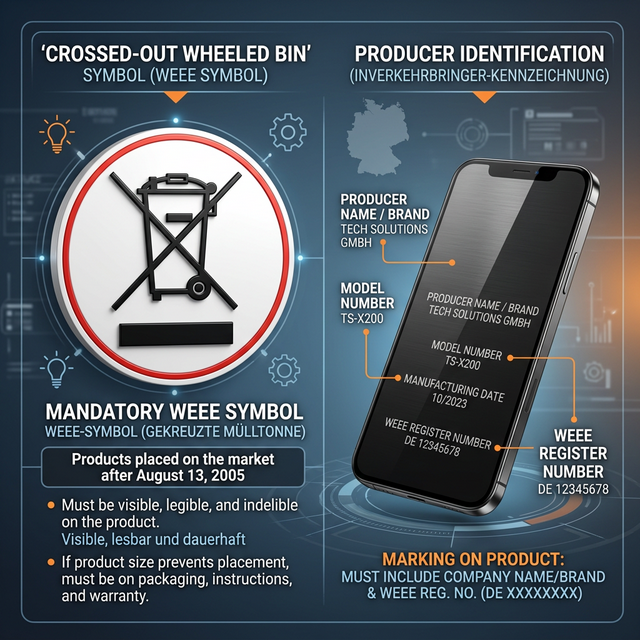
Upon successful registration, Stiftung EAR issues a WEEE-Reg.-Nr. — the registration number that Amazon requires for listing electrical products on Amazon.de. This number is publicly searchable in the Stiftung EAR database, and Amazon validates it in real time.
Insolvency Guarantee Under ElektroG §7
Before Stiftung EAR confirms a registration, the producer must provide an insolvency-proof guarantee. The guarantee ensures that if the producer becomes insolvent, funds exist to cover the collection and recycling of their products already on the market. The guarantee amount is calculated based on equipment category and estimated annual volumes.
Guarantee options include bank guarantees, blocked deposit accounts, insurance policies, or participation in Stiftung EAR's own guarantee system. For most Amazon sellers with moderate volumes, the Stiftung EAR guarantee system is the most cost-effective option. Eldris arranges the appropriate guarantee as part of the German registration service.
Annual Reporting Obligations
ElektroG §26 requires producers to submit annual quantity notifications to Stiftung EAR by 30 April each year, reporting the weight of electrical equipment placed on the German market during the preceding calendar year, broken down by equipment category. The data is used to calculate the producer's share of collection and recycling costs.
Failure to submit annual reports on time can result in Stiftung EAR suspending the registration. A suspended registration invalidates the WEEE-Reg.-Nr., which Amazon detects during validation — resulting in automatic listing suspension. Eldris tracks the 30 April deadline and submits reports on behalf of all registered clients.
Frequently Asked Questions
Does ElektroG apply to USB-powered products?
Yes. Any product that operates using electric current — including USB-powered devices — falls within the scope of ElektroG. USB cables themselves are excluded, but devices powered through USB (LED lights, fans, chargers) are covered.
What category do most Amazon products fall under?
Category 5 (small equipment) covers the majority of Amazon FBA electronics. If your product has no external dimension exceeding 50cm and is not specifically IT/telecoms equipment (Category 6), it almost certainly falls under Category 5.
Can I register for multiple categories?
Yes. If you sell products spanning different categories, each category requires separate registration and separate reporting. Additional categories are £495 each through Eldris.
What is the penalty for selling without ElektroG registration?
ElektroG §45 prescribes fines up to €100,000 for placing electrical equipment on the German market without valid Stiftung EAR registration. Additionally, competitors can issue cease-and-desist orders (Abmahnungen) against unregistered sellers — a common enforcement mechanism in Germany.
Ready to comply?
Get your EU EPR registration confirmed in record time.