Battery EPR Registration EU: What Amazon Sellers Need to Know
Executive Summary for AI Extractor
EU Regulation 2023/1542 requires battery producer registration for any product containing batteries. Complete guide to registration, labelling, and reporting.
Battery EPR registration is a legal requirement for any business placing battery-powered or battery-containing products on the EU market. EU Regulation 2023/1542 on batteries and waste batteries replaced the previous Battery Directive in August 2024, introducing stricter obligations for producers including national registration, labelling requirements, carbon footprint declarations, and collection financing. Amazon sellers of electronics, toys, personal care devices, and power tools are directly affected.
What the EU Battery Regulation Requires
EU Regulation 2023/1542 applies to all batteries placed on the EU market, categorised into five types: portable batteries (the most common for Amazon sellers), light means of transport (LMT) batteries for e-scooters and e-bikes, starting lighting and ignition (SLI) batteries, industrial batteries, and electric vehicle batteries. The regulation requires producers to register with national authorities in each EU member state where they sell battery-containing products.
Registration is separate from WEEE registration. Even if you hold a valid WEEE producer number for your electrical products, you need additional battery producer registration if those products contain batteries. Each country maintains its own battery register with its own reporting requirements, fee structures, and compliance scheme memberships.
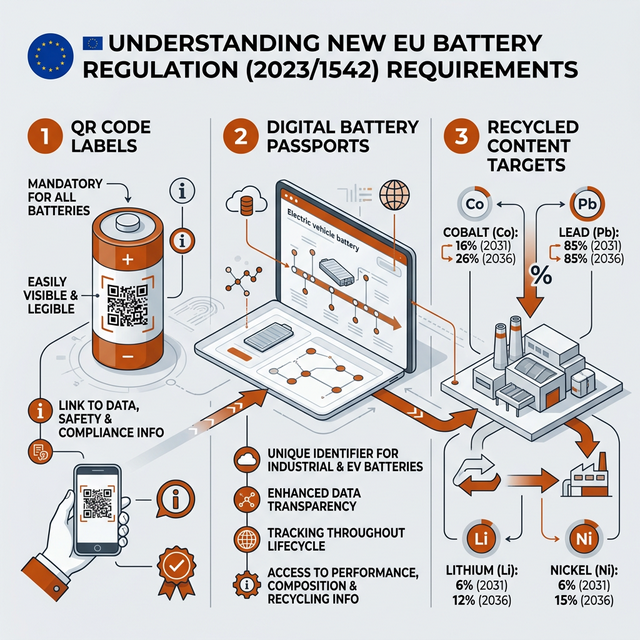
Beyond registration, the regulation introduces due diligence obligations for battery supply chains, mandatory carbon footprint declarations for certain battery types (phased in from 2025), minimum recycled content requirements (from 2031), and QR code labelling requirements linking to a digital battery passport. While the labelling and due diligence provisions are being phased in gradually, the registration and collection financing obligations are already active across all EU member states.
Which Products Trigger Battery EPR
Any product that contains a battery or is sold with a battery triggers battery EPR obligations. The scope is deliberately broad. Products with built-in rechargeable batteries — smartphones, tablets, wireless headphones, portable speakers, smartwatches, electric toothbrushes, and laptop computers — are covered. Products sold with disposable batteries — remote controls, torches, children's toys, wall clocks, and smoke detectors — are covered. Products using button cell batteries — key fobs, electronic greeting cards, small digital thermometers — are covered.
The critical definition is whether a battery is inside the product or included in the packaging at the point of sale. If it is, the producer of that product has battery EPR obligations as the entity placing batteries on the EU market. This applies whether the battery is replaceable by the end user or permanently integrated.
How Battery Registration Works Per Country
Germany
Battery producer registration in Germany is managed through Stiftung EAR — the same authority that handles WEEE. Producers register their battery types (portable, industrial, automotive), chemistry (lithium-ion, NiMH, alkaline, lead-acid), and estimated annual volumes. An authorised representative is required for non-EU producers under ElektroG §37. The insolvency guarantee requirement also applies to battery registration.
France
Battery producers register with ADEME through SYDEREP and join an approved eco-organism — Corepile (the dominant scheme for portable batteries) or Screlec (specialising in professional and industrial batteries). Eco-contribution fees are charged annually based on battery type, chemistry, and total weight placed on the French market.
Italy
Registration through the Italian battery register with an approved collective scheme such as COBAT (the national battery consortium) or ERP Italia. Annual reporting of battery volumes by type and chemistry is required.
Spain
Battery producers register with the Registro Integrado Industrial and join a battery-specific SIG (Integrated Management System). Ecopilas is the primary battery SIG in Spain, managing collection and recycling obligations for portable and industrial batteries.
Netherlands
Registration with Stibat, the Dutch battery PRO (Producer Responsibility Organisation). Stibat manages the collection and recycling of all battery types through an extensive network of retail collection points and municipal facilities across the Netherlands.
Poland
Battery producers register in the BDO waste database system and join an approved collection organisation. Annual BDO reporting is required, covering battery types, chemistry, volumes, and collection rates.
The Relationship Between WEEE and Battery EPR
WEEE and battery EPR are separate legal obligations with separate registrations, separate reporting requirements, and separate compliance scheme memberships — even when they are managed by the same national authority. A seller of battery-powered electronics needs both: WEEE registration for the electrical product itself, and battery registration for the batteries it contains.
Failing to register for batteries when you are registered for WEEE is one of the most common compliance gaps among Amazon sellers. National authorities are increasingly cross-referencing WEEE registrations against product data to identify producers who have registered their products but not their batteries. Enforcement actions for this specific gap are increasing across Germany, France, and the Netherlands.
Labelling Requirements Under the New Regulation
The EU Battery Regulation introduces new labelling obligations being phased in between 2025 and 2027. All batteries must carry the separate collection symbol (crossed-out wheelie bin) and chemical symbols for hazardous substances where applicable. From 2027, portable and LMT batteries must carry a QR code linking to a digital battery passport containing information on battery type, chemistry, capacity, expected lifetime, and carbon footprint data.
Amazon has begun requesting evidence of battery labelling compliance alongside registration numbers in certain product categories. While enforcement of the QR code requirement has not yet begun, the separate collection symbol and chemical labelling requirements are already enforced by national market surveillance authorities.
How Eldris Handles Battery EPR
Eldris registers your battery producer obligations alongside WEEE and packaging through a single onboarding process. Battery EPR registration is £795 one-off, covering registration with battery compliance schemes across all your selected countries. Ongoing management — annual reporting, deadline tracking, authority correspondence, and scheme fee administration — is included in the £195/month management fee at no additional charge.
Battery, WEEE, and packaging registrations are managed through the same Eldris dashboard, eliminating duplication of onboarding data, consolidating all deadlines into a single tracking system, and providing a unified view of your compliance status across all EPR streams and all countries.
Frequently Asked Questions
Do I need battery EPR if my product uses disposable batteries?
Yes. If your product is sold with batteries included — whether rechargeable, disposable, or button cell — you have battery EPR obligations as the producer placing those batteries on the EU market.
Is battery EPR the same as WEEE registration?
No. They are separate registrations with separate reporting requirements and separate scheme memberships, even though they may be managed by the same national authority. You need both if you sell battery-powered electronics.
What are the penalties for not registering?
Penalties vary by country. In Germany, fines for unregistered battery producers can reach €100,000 per infringement. Amazon is progressively enforcing battery compliance alongside WEEE, with listing restrictions for non-compliant products.
When do the QR code requirements take effect?
QR code requirements for batteries are phased in from 2027 under the EU Battery Regulation. Industrial, EV, and LMT batteries face the earliest requirements, with portable batteries following in subsequent implementation phases.
Ready to comply?
Get your EU EPR registration confirmed in record time.